
Private Letter Rulings - Foster Care Home Operator's Exempt Status Is Revoked
GiftLaw Note:
ORG is a non-profit corporation. Its purpose is to own and operate foster homes for children who are in the custody of State. ORG's governing body consists of five directors. Two of the directors also serve as President and Vice-President of ORG. President and Vice-President live at the home and operate it with minimal help from volunteers and part-time employees. President and Vice-President adopted the six children currently living at the home so that they are no longer in State's custody. Currently the home has six children, but President and Vice-President hope to eventually serve eight children.
Section 501(c)(3) provides that an organization is exempt from federal income tax if it is organized and operated exclusively for exempt purposes. Section 1.501(c)(3)-1(c)(1) states that an organization will not be operated exclusively for exempt purposes if more than an insubstantial part of its activities is not in furtherance of an exempt purpose. Additionally, under Section 1.501(c)(3)-1(d)(1)(ii) in order for an organization to be operated exclusively for exempt purposes it must serve a public rather than a private interest. Here, the Service found that ORG does not operate exclusively for exempt purposes. First, ORG's purpose of owning and operating foster homes for children was nullified when the children were adopted by President and Vice-President and ceased to be foster children. Second, ORG was operated to serve a private rather than a public interest. The President, Vice-President and the adopted children were all substantial beneficiaries of the services offered by ORG. As a result, ORG does not operate exclusively for exempt purposes and the Service revoked ORG's exempt status.
Section 501(c)(3) provides that an organization is exempt from federal income tax if it is organized and operated exclusively for exempt purposes. Section 1.501(c)(3)-1(c)(1) states that an organization will not be operated exclusively for exempt purposes if more than an insubstantial part of its activities is not in furtherance of an exempt purpose. Additionally, under Section 1.501(c)(3)-1(d)(1)(ii) in order for an organization to be operated exclusively for exempt purposes it must serve a public rather than a private interest. Here, the Service found that ORG does not operate exclusively for exempt purposes. First, ORG's purpose of owning and operating foster homes for children was nullified when the children were adopted by President and Vice-President and ceased to be foster children. Second, ORG was operated to serve a private rather than a public interest. The President, Vice-President and the adopted children were all substantial beneficiaries of the services offered by ORG. As a result, ORG does not operate exclusively for exempt purposes and the Service revoked ORG's exempt status.
2/7/2014 (08/27/2009)
Dear * * *:
This is a final adverse determination as to your exempt status under section 501(c)(3) of the Internal Revenue Code (IRC). It is determined that you are no longer recognized as exempt from Federal income tax under IRC section 501(c)(3), effective January 1, 20* * * for the following reason(s):
Section 1.501(c)(3)-1(c)(1) of the regulations provides that an organization will be regarded as "operated exclusively" for one or more exempt purposes only if it engages primarily in activities that accomplish one or more of such exempt purposes specified in section 501(c)(3). An organization will not be so regarded if more than an insubstantial part of its activities is not in furtherance of an exempt purpose. The existence of a substantial nonexempt purpose, regardless of the number or importance of exempt purposes, will cause failure of the operational test.
You do not operate exclusively for charitable purposes and your primary activities are not in the furtherance of section 501(c)(3) purposes. You have a substantial non-exempt purpose and provide benefits to private individuals -- providing services to the adopted children of the officers/directors of your organization.
Contributions to your organization are not deductible under IRC section 170.
You are required to file Federal income tax returns on the form indicated above. You should file these returns within 30 days from the date of this letter, unless a request for an extension of time is granted. File the returns in accordance with their instructions, and do not send them to this office. Processing of income tax returns and assessment of any taxes due will not be delayed because you have filed a petition for declaratory judgment under IRC section 7428.
If you decide to contest this determination under the declaratory judgment provisions of IRC section 7428, a petition to the United States Tax Court, the United States Court of Claims, or the district court of the United States for the District of Columbia must be filed within 90 days from the date this determination letter was mailed to you. Contact the clerk of the appropriate court for rules for filing petitions for declaratory judgment. To secure a petition form from the United States Tax Court, write to the United States Tax Court, 400 Second Street, N.W., Washington, D.C. 20217.
You also have the right to contact the Office of the Taxpayer Advocate. However, you should first contact the person whose name and telephone number are shown above since this person can access your tax information and can help you get answers. You can call 1-877-777-4778 and ask for Taxpayer Advocate assistance or you can contact your nearest Advocate's office, in this case by calling 713-209-3660 or writing to:
* * *
Taxpayer Advocate assistance cannot be used as a substitute for established IRS procedures, formal appeals processes, etc. The Taxpayer Advocate is not able to reverse legal or technically correct tax determinations, nor extend the time fixed by law that you have to file a petition in Court. The Taxpayer Advocate can, however, see that a tax matter that may not have been resolved through normal channels gets prompt and proper handling.
If you have any questions, please contact the person whose name and telephone number are shown in the heading of this letter.
Sincerely
Douglas H. Shulman
Commissioner
By Sunita Lough
Director, EO Examinations
Date: May 13, 2009
Dear * * *:
We have enclosed a copy of our report of examination explaining why we believe revocation of your exempt status under section 501(c)(3) of the Internal Revenue Code (Code) is necessary.
If you accept our findings, take no further action. We will issue a final revocation letter.
If you do not agree with our proposed revocation, you must submit to us a written request for Appeals Office consideration within 30 days from the date of this letter to protest our decision. Your protest should include a statement of the facts, the applicable law, and arguments in support of your position.
An Appeals officer will review your case. The Appeals office is independent of the Director, EO Examinations. The Appeals Office resolves most disputes informally and promptly. The enclosed Publication 3498, The Examination Process, and Publication 892, Exempt Organizations Appeal Procedures for Unagreed Issues, explain how to appeal an Internal Revenue Service (IRS) decision. Publication 3498 also includes information on your rights as a taxpayer and the IRS collection process.
You may also request that we refer this matter for technical advice as explained in Publication 892. If we issue a determination letter to you based on technical advice, no further administrative appeal is available to you within the IRS regarding the issue that was the subject of the technical advice.
If we do not hear from you within 30 days from the date of this letter, we will process your case based on the recommendations shown in the report of examination. If you do not protest this proposed determination within 30 days from the date of this letter, the IRS will consider it to be a failure to exhaust your available administrative remedies. Section 7428(b)(2) of the Code provides, in part: "A declaratory judgment or decree under this section shall not be issued in any proceeding unless the Tax Court, the Claims Court, or the District Court of the United States for the District of Columbia determines that the organization involved has exhausted its administrative remedies within the Internal Revenue Service." We will then issue a final revocation letter. We will also notify the appropriate state officials of the revocation in accordance with section 6104(c) of the Code.
You have the right to contact the office of the Taxpayer Advocate. Taxpayer Advocate assistance is not a substitute for established IRS procedures, such as the formal appeals process. The Taxpayer Advocate cannot reverse a legally correct tax determination, or extend the time fixed by law that you have to file a petition in a United States court. The Taxpayer Advocate can, however, see that a tax matter that may not have been resolved through normal channels gets prompt and proper handling. You may call toll-free 1-877-777-4778 and ask for Taxpayer Advocate Assistance. If you prefer, you may contact your local Taxpayer Advocate at:
* * *
If you have any questions, please call the contact person at the telephone number shown in the heading of this letter. If you write, please provide a telephone number and the most convenient time to call if we need to contact you.
Thank you for your cooperation.
Sincerely,
Sunita B. Lough
Director, EO Examinations

ISSUE
Whether ORG (ORG) is operated exclusively for exempt purposes described within Internal Revenue Code section 501(c)(3):
a. Whether ORG is engaged primarily in activities that accomplish an exempt purpose?
b. Whether more than an insubstantial part of ORG's activities are in furtherance of a non-exempt purpose?
c. Whether ORG was operated for the purpose of serving a private benefit rather than public interests?
FACTS
History
On February 14, 20XX, ORG was incorporated under the laws of the State of State as a non-stock, nonprofit corporation. ORG's original address was Address, City, State and the current address is Address, City, State.The Articles of Incorporation state "the purpose of ORG is to own and operate foster homes for children". The Bylaws state "the purpose of ORG is to establish and maintain a home for children who are in the state foster care system by providing for the children all of those things necessary for a normal, happy life, including shelter, food, clothing care, affection, training, recreation, education and religious training".
The initial governing body of ORG included the following individuals:
President -- President/Director
Vice President -- Vice President/Director
DIR-1 -- Director
DIR-2 -- Director
DIR-3 -- Director
On February 24, 20XX, the Form 1023, Application for Recognition of Exemption Under Section 501(c)(3) of the Internal Revenue Code was filed with the Internal Revenue Service (IRS). The Application states "the charitable purpose of ORG is to provide foster care services to children in the following ways: The primary activity will be to own and operate foster homes for children who are in the custody of the State Department of Protective and Regulatory Services because they have either been abandoned by their parents or they have been taken from their parents because of abuse or neglect. All children who are placed in the homes will be provided with those things necessary for a normal, happy life, including shelter, food, clothing care, affection, training, recreation, education and religious training. These services will be provided to any child placed into the home by the state, without regard for the child's race, religion or ethnic heritage. The first child was received into the home on February 5, 20XX. In the future, the home will provide services to as many as six children at any one time. A suitable new building for this purpose will be purchased in the next few months in or new City, State. In the future, additional buildings and expansions may take place which will allow for additional children to be taken in. The home will be maintained and operated by President and Vice President."
IRS correspondence dated July 11, 20XX was sent to ORG requesting additional information needed to make the determination on the Form 1023. ORG correspondence dated July 29, 20XX was forwarded to the IRS with the following responses to the questions listed below:
1. How many foster homes does your organization operate? Does your organization own all of the foster homes that it is operating? If not, who own them? Are the owners related to your organization other than landlord? If so, please provide details.
Answer: The organization is in a start-up phase using a house purchased by two of the directors, President and Vice President. There are no immediate plans to add an additional home. The organization will have a security interest in the home.
2. Please provide details on all the services being provided at each of the above homes.
Answer: President and Vice President have been trained and licensed by the State of State to operate foster home. The home could also be called an orphanage. The state has given the custody of foster children to the President-Vice-President. The children are raised in the home and provided all of the necessities of life such as shelter, food, protection, clothing, training, medical and dental care, education, etc. The children have been taken from their natural homes by the State due to severe abuse and or neglect. The children have complex problems that the foster home will deal with. The home took in one child in February 20XX, one child in March 20XX and two children in April 20XX. (All of the children are maternal brothers.) One of the two children received in April had to be move temporarily to a more specialized home because of his severe emotional problems. That child should be returned to the home 60-90 days. It is highly unlikely that these children can be returned to their natural parent. It is hoped that the home will be able to eventually serve 8 children.
3. Will anyone use the above facilities (homes) other for the purpose of directly carrying out your work? Will any of your directors or employees reside at your facility? If so, explain fully.
Answer: President and Vice President will live at the home and operate it with minimal help from volunteers and part-time employees. The President-Vice-President will do * * *% of the work of the organization. The work is 7 days a week, 24 hours a day. The President-Vice-President are not compensated for this work. The home will not be used for any other purpose than a foster home.
Based on the supplied information and assuming operations would be as stated in the application for recognition of exemption, a determination letter dated August 27, 20XX, was issued to ORG recognizing it to be exempt from federal income tax as an organization described in IRC Section 501(c)(3). Since ORG was a newly created organization, the final determination was not made on the foundation status. The advance ruling period began February 14, 20XX and ends on December 31, 20XX. During this advance ruling period, ORG will be treated as a publicly supported organization and not as a private foundation.
Promissory Note and Deed of Trust
President and Vice President (Maker) negotiated a promissory note (Note) dated June 5, 20XX with ORG (Payee) for $* * * at * * *% interest per annum due on or before June 5, 20XX (principal and interest). The Note was secured by a deed of trust executed by Maker to DIR-1, Trustee for the benefit of the Payee covering the real property. Other general provisions of the note include: The Payee agrees that no interest will be due and payable on the Note as long as the Property is used for purposes consistent with the mission of ORG. The Payee agrees that the Note will not be enforceable against the Makers, their heirs or assigns as long as the Property is used for purpose consistent with the mission of ORG.President and Vice President (Grantor) negotiated a Deed of Trust (Deed) dated June 5, 20XX with DIR-1 (Trustee) and ORG (Beneficiary) for $* * *. For the value received and to secure payment of the Note, the Grantor conveys the Property to Trustee in trust. The Grantor warrants and agrees to defend the title to the Property. If Grantor performs all of the covenants and pays the Note according to its terms, the Deed shall have no further effect and the Beneficiary shall release it at Grantor's expense.
Minutes and Email Correspondence
ORG email correspondence dated June 6, 20XX stated that the President-Vice-President moved on June 7, 20XX into new mission home located at Address, City, State.ORG minutes dated July 4, 20XX, described the financial affairs and the purchase of a mission home for the organization. ORG's finance summary showed $* * * (to date) in contributions had been received primarily from the following two contributors: RA-1, $* * * and CO-1, $$* * *. The purchase of the mission home discussion stated that the purchase price of the home was $$* * * with $$* * * coming from ORG funds and $$* * * from personal funds from the President-Vice-President. The discussion also included that the property would be deeded to the President-Vice-President and that a Deed of Trust would be executed by the President-Vice-President for the amount paid by ORG. The ownership in the name of the President-Vice-President was done to make insurance and ad valorem issues much simpler. Also, many of the necessary renovations and improvements were being paid by the President-Vice-President. The Board agreed that the Deed of Trust should not charge interest on the loan as long as the house is used as a mission house. President suggested that it would be in the best interest of ORG to seek the advice of tax counsel on how best to go forward with ownership issues. The Board by consensus approved the financial report.
ORG email correspondence dated August 31, 20XX stated that the two sources of income were to be President's pension and state monthly reimbursements. The pension had to be used to pay the expenses for the President-Vice-President old house (not yet sold) and the state was two months behind on reimbursements.
ORG minutes dated April 17, 20XX, described the ownership of the mission house and the custody status of the children. The mission house was in the President-Vice-President name with the Deed of Trust from the President-Vice-President to ORG as discussed in the last meeting of the Board of Directors. President stated that the original amount of the Deed of Trust was $$* * * and that $$* * * had been paid on the note to date. The termination of the birth mother's parental rights had occurred and that termination of all alleged and unknown father's rights was proceeding. It was stated that adoption of the children would take place by this summer. There was also a general discussion led by President regarding the possibility of adding 1-2 infants and making necessary/desirable renovations and repairs to the mission house. The basic budget of ORG was reviewed including the fact that subsidies from the state would be lowered when the children were adopted.
ORG email correspondence dated April 22, 20XX stated that the old house sale closed.
ORG email correspondence dated May 18, 20XX stated that the parental rights had been terminated and that the adoption process would begin shortly.
ORG email correspondence dated July 8, 20XX stated that another child was being placed in foster care but that the President-Vice-President would not be able to adopt the child right away.
ORG email correspondence dated July 12, 20XX stated that the fifth child (maternal brother of other boys) was picked up and placed in the President-Vice-President care.
On November 23, 20XX an Order of Adoption was filed in City, State ordering and granting the adoption of the first four children and that the parent-child relationship was created between the children and Petitioners, President and Vice President, (President/Director and Vice-President of ORG) for all purposes.
ORG email correspondence dated April 13, 20XX stated that the fifth child's placement with the President-Vice-President would continue with the goal of adoption.
ORG email correspondence dated June 16, 20XX stated that the jury trial set for the fifth child was continued.
Website
ORG website address is temporarily located at website. It details the history, purpose, philosophy and progress of the ORG. The purpose states that ORG is to establish and maintain a home for children who were in the state foster care system by providing for the children all of the those things necessary for a normal, happy life, including shelter, food, clothing, care, affection, training, recreation, education and religious training. The philosophy states that the President-Vice-President have worked with disadvantaged children for many years. They have been called to focus on one sibling group of children who have a history of abuse and neglect. The children will be given every opportunity to heal, grow and thrive. The history states ORG was founded in 20XX and approved as a 501(c)(3) organization under the Internal Revenue Code. Four foster children were taken into the home on February 5, March 5 and May 5 (2 children), 20XX, respectively. On November 23, 20XX, the four boys were adopted by the * * * family. Additionally, another child was taken into the home on July 12, 20XX, and adopted on January 19, 20XX. The five boys are maternal brothers. The Progress states the long term goal is to have each child ready to take their place in society by the time they reach college age.Federal Tax Returns and Financial History
The Form 990 was filed for the 20XX tax year only. Since ORG did not meet the $* * * income filing requirement, no other returns have been filed since the 20XX tax year.ORG's Form 1023, Application Recognition of Exemption Under Section 501(c)(3) stated that the organization would be supported by donations from private individuals, corporations and churches. Some expenses would be reimbursed by the state and no fees would be charged to any child receiving services or their families.
ORG's financial records are maintained on QuickBooks software program by President for the 20XX tax year. The submitted 20XX profit and loss statement shows the following income and expenses:
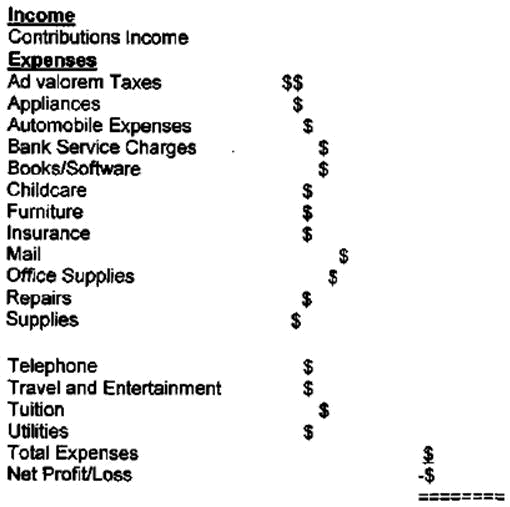
After the children were adopted in 20XX, the officers/directors of ORG entered into a Plan of Service and Adoption Assistance Agreement for each of the children as the adoptive parents. The Post Adoption Contract Services are provided to children who were in the custody of the State Department of Protective and Regulatory Services (Department) at the time of adoption. CO-2 is the contractor for the Department to administer Post Adoptive Services through the Plan of Service. The plan of service provides the following authorized interventions: casework services; therapeutic counseling that includes family, individual, group and therapeutic camping; respite care; parent training and support. The Adoption Assistance Agreement provides: Medicaid health, vision and dental coverage for each child until they reach age 18 through the State Medicaid Program; monthly assistance payments of $* * * for each child for the period 11/1/20XX until 10/31/20XX; reimbursement of one-time only payment (maximum of $* * * per child) for reasonable and necessary adoption fees, court costs, attorney fees, and other expenses directly related to the legal adoption of special needs children. The Post Adoptive program also includes other benefits such as free tuition for college at any state chartered university or college for the children.
LAW
Section 501(a) of the Internal Revenue Code provides that an organization described in section 501(c)(3) is exempt from income tax. Section 501(c)(3) of the Code exempts from federal income tax corporations organized and operated exclusively for charitable, educational, and other purposes, provided that no part of the net earnings inure to the benefit of any private shareholder or individual.
Section 1.501(c)(3)-1(a)(1) of the regulations provides that, in order to be exempt as an organization described in section 501(c)(3), an organization must be both organized and operated exclusively for one or more of the purposes specified in such section. If an organization fails to meet either the organizational test or the operational test, it is not exempt.
Section 1.501(c)(3)-1(b)(1)(i) of the Code provides that an organization is organized exclusively for one or more exempt purposes only if its articles of organization (referred to in this section as its "articles") as defined in subparagraph (2) of this paragraph:
(a) Limit the purposes of such organization to one or more exempt purposes; and
(b) Do not expressly empower the organization to engage, otherwise than as an insubstantial part of its activities, in activities which in themselves are not in furtherance of one or more exempt purposes.
Section 1.501(c)(3)-1(c)(1) of the regulations provides that an organization will be regarded as "operated exclusively" for one or more exempt purposes only if it engages primarily in activities that accomplish one or more of such exempt purposes specified in section 501(c)(3). An organization will not be so regarded if more than an insubstantial part of its activities is not in furtherance of an exempt purpose. The existence of a substantial nonexempt purpose, regardless of the number or importance of exempt purposes, will cause failure of the operational test. In Better Business Bureau of Washington D.C., Inc. v. United States, 326 U.S. 279 (1945), the Supreme Court held that the presence of a single non-exempt purpose, if substantial in nature will destroy the exemption regardless of the number or importance of truly exempt purposes.
Section 1.501(c)(3)-1(c)(2) of the regulations provides that an organization is not operated exclusively for one or more exempt purposes if its net earnings inure in whole or in part to the benefit of private shareholders or individuals.
Section 1.501(a)-1(c) defines the words "private shareholder or individual" in section 501 to refer to persons having a personal and private interest in the activities of the organization.
Section 1.501(c)(3)-1(d)(1)(ii) of the regulations provides that an organization is not organized or operated exclusively for one or more exempt purposes unless it serves a public rather than a private interest. Thus, to meet the requirements of this subsection, it is necessary for an organization to establish that it is not organized or operated for the benefit of private interests, such as designated individuals, the creator or his family, shareholders of the organization, or persons controlled, directly or indirectly, by such private interests. Private benefits include an "advantage; profit; fruit; privilege; gain; [or] interest." Retired Teachers Legal Fund v. Commissioner, 78 T.C. 280, 286 (1982).
In Wendy L. Parker Rehabilitation Foundation, Inc (Petitioner), v. C.I.R. T.C. Memo. 1986-348, 1986 WL 21552 (US Tax Ct.), 52 T.C.M. (CCH) 51, T.C.M. (P-H) P 86,348, 1986 PH TC Memo 86,348, the issue presented for consideration is whether Petitioner meets the section 501(c)(3) requirement that no part of its net earnings inure to the benefit of a private individual. The Petitioner was formed to aid the victims of coma. The Court agreed with respondent that Petitioners failed the private inurement test because of its projected expenditures and distribution of funds for the benefit of Wendy Parker. Wendy Parker is one of the recovering coma patients as well as the daughter and sister of the Petitioner's officers. The Court held that the officers and Wendy Parker have a personal interest in Petitioner's affairs to provide assistance to Wendy Parker and other coma patients. In addition, they are "private individuals" within the meaning of section 1.501(a)-1(c) of the Internal Revenue Regulations. The distributed funds were used to pay for the medical and rehabilitative care of Wendy Parker. This relieves the Parker family of the economic burden of providing such care. Consequently, there is a prohibitive benefit from Petitioner's funds that inures to the benefit of private individuals.
Revenue Ruling 72-147, 1972-1 C.B. 147, held that an organization that provided housing to low income families did not qualify for exemption under section 501(c)(3) because it gave preference to employees of a business operated by the individual who also controlled the organization. The ruling reasoned that, although providing housing for low-income families furthers charitable purposes, doing so in a manner that gives preference to employees of the founder's business primarily serves the private interest of the founder rather than a public interest.
Section 1.501(c)(3)-1(d)(2) of the regulations provides that the term "charitable" is used in section 501(c)(3) of the Code in its generally accepted legal sense and includes relief of the poor and distressed or of the underprivileged as well as the advancement of education.
Section 1.501(c)(3)-1(d)(3) of the regulations provides that the term "educational" refers to:
(a) The instruction or training of the individual for the purpose of improving or developing his capabilities; or
(b) The instruction of the public on subjects useful to the individual and beneficial to the community.
In Revenue Ruling 77-3, 1977-1 CB 140, advice was requested whether the non-profit organization which otherwise qualifies for exemption from Federal income tax under section 501(c)(3) of the Internal Revenue Code is operated exclusively for charitable purposes. The organization was formed for the purpose of leasing housing to a city at cost. The city uses the housing to accommodate families whose homes or apartments have been destroyed by fire. The housing is furnished to these families on a temporary basis, pending their relocation to permanent housing. The lease contract requires that the organization make all necessary repairs, provide adequate winter heating, provide security guards, and perform other services normally associated with providing rental housing. The city selects the tenants, determines their length of stay and makes arrangements for their permanent housing. The temporary housing is furnished to families by the city at no charge and without regard to their ability to pay. The organization's receipts come entirely from the city, and its disbursements are made solely in connection with the furnishing of the housing and the related services, including salaries to its employees who provide the services required by the contract. Providing free rescue and emergency services to distressed persons suffering because of fire, flood, accident or other disaster is recognized in Revenue Ruling 69-174, 1969-1 C.B. 149, as a charitable activity. Similarly, the providing of free temporary housing to distressed persons in need of adequate housing is a charitable activity. However, in the instant case, it is the city rather than the organization that is providing free temporary housing to the distressed families. The organization is merely leasing housing property and providing certain maintenance and other services in connection therewith to the city at cost in a manner similar to organizations operated for profit, and is not itself engaged in charitable activities. Accordingly, the organization is not operated exclusively for charitable purposes and does not qualify for exemption from Federal income tax under section 501(c)(3) of the Code.
TAXPAYERS POSITION
Examiner determined that the exempt purpose of ORG no longer exist since the children were no longer in "foster care". Examiner explained the original purpose of ORG was nullified with the adoption of the children. The President/Director was surprised (by his own admission) to see that ORG was characterized as a business to own and operate foster homes as noted in ORG's governing documents, application and the 20XX 990 federal tax return. Per President, the current purpose "is to establish and maintain a home for children who were in the state foster care system by providing for the children all those things necessary for a normal, happy life, including shelter, food, clothing, care, affection, training, recreation, education and religious training". The President reiterated the discussions of adoption in the board of directors meeting dated April 17, 20XX and that the intent was always to foster to adopt the children. Per the President, it was their intent to always be characterized as a foster/adopt organization. Per Power of Attorney (POA), the initial intent was to provide foster care but in order to keep the children together the officers/directors adopted the children. POA stated that the officers/directors actions were not to cheat the government and not willfully intentional. POA stated that it is a substance versus form issue. POA stated that the adoption came in later and setup may have been incorrect form but that ORG had the right intent (substance).
GOVERNMENT'S POSITION
An organization must not engage in substantial activities that fail to further an exempt purpose. Furthermore, an organization must not operate for the benefit of the private individuals. ORG does not operate exclusively for section 501(c)(3) purposes, rather it has a substantial non-exempt purpose. ORG's governing documents state "the purpose of ORG is to own and operate foster homes for children". The documents further explain "the purpose of ORG is to establish and maintain a home for children who are in the state foster care system by providing for the children all of those things necessary for a normal, happy life, including shelter, food, clothing care, affection, training, recreation, education and religious training". It was determined that the original purpose of ORG was nullified with the adoption of the children. ORG's primary activity consists of raising and providing all of the necessities of life such as shelter, food, protection, clothing, training, medical and dental care, education, etc., to the "adopted" children of the officers/directors (adoptive parents) of ORG.
It was determined that the exempt purpose of the ORG no longer existed since the children were no longer in "foster care". Four of the five children were legally adopted in November 20XX. Since more than an insubstantial part of ORG's activities are in the furtherance of private interests it is not operated exclusively for the furtherance of an exempt purpose under section 501(c)(3). This is similar to the organization in Better Business Bureau of Washington, D.C. where the Supreme Court held that the presence of a single non-exempt purpose, if substantial in nature will destroy the exemption regardless of the number or importance of truly exempt purposes.
Also, to operate exclusively for exempt purposes, an organization must serve a public rather than a private interest; consequently, an organization that operates for the benefit of private interests such as the creator or his family does not operate exclusively for exempt purposes. In this case, the President/Director and Vice President/Director of ORG and their adopted children were the substantial beneficiaries of the services offered by the organization. This constitutes inurement which is prohibited under Code Section 501(c)(3) and the Regulations. ORG's operations are similar to the organization, Wendy L. Parker Rehabilitation Foundation, Inc., that concluded that a prohibitive benefit occurred between private individuals and the exempt organization. Even if an organization's activities serve a charitable class or are otherwise charitable within the meaning of section 501(c)(3), it must demonstrate that its activities serve a public rather than a private interest within the meaning of section 1.501(c)(3)-1(d)(1) of the regulations. In Revenue Ruling 72-147, 1972-1 C.B. 147, an organization's activities serve a charitable class or are otherwise charitable within the meaning of 501(c)(3) but in doing so it gives preference to employees of a business operated by the individual who also controlled the organization. Likewise, the officers/directors/adoptive parents of ORG and their adopted children received preferential benefit from the services. Thus, ORG served a private interest rather than a public interest and does not operate exclusively for exempt purposes.
Similarly, in Revenue Ruling 77-3, 1977-1 CB 140, it reasons that the State of State and the adoptive parents were providing the majority of relief for the children rather than ORG. The officers/directors were receiving the majority of the funds and services as the adoptive parents of the children rather than ORG. Initially, the officers/directors used contributions from the public and their personal funds to purchase the mission home, care for the children and maintain the mission home. Based on ORG's financial records for the period covering January through December 20XX, ORG received minimal contributions from the public. During 20XX, the adoptive parents used personal funds and received the majority of the funds and services to care for the children and maintain the mission home from the State of State. In 20XX, ORG provided $$* * * of its funds from contributors to purchase the mission home. The officers/directors used $$* * * of their personal funds to complete the purchase of the mission home. The officers/directors negotiated a $$* * * promissory note and Deed of Trust with ORG for the use of ORG funds to purchase the mission home. The Board of Directors approved the deeding of the mission home in the officers/directors name to simplify the ad valorem taxes and insurance on the home. The Board also approved a stipulation in the promissory note that as long as the home is used as a mission home that the * * *% stated interest would not be charged on the note. The officers/directors have been repaying the note and at the end of 20XX, the officers/directors had paid a total of $* * * toward the promissory note. ORG advanced the officers/directors a no interest loan to purchase the housing property. Additional ORG funds were used to provide certain maintenance and upkeep of the home in a manner similar to organizations operated for profit, and is not itself engaged in charitable activities. Accordingly, the organization is not operated exclusively for charitable purposes and does not qualify for exemption from Federal income tax under section 501(c)(3) of the Code.
EFFECTIVE DATE OF REVOCATION
An organization may ordinarily rely on a favorable determination letter received from the Internal Revenue Service. Treas. Reg. § 1.501(a)-1(a)(2); Rev. Proc. 20XX-4, § 14.01 (cross-referencing § 13.01 et seq.), 20XX-1 C.B. 123. An organization may not rely on a favorable determination letter, however, if the organization omitted or misstated a material fact in its application or in supporting documents. In addition, an organization may not rely on a favorable determination if there is a material change, inconsistent with exemption, in the organization's character, purposes, or methods of operation after the determination letter is issued. Treas. Reg. § 601.201(n)(3)(ii); Rev. Proc. 90-27, § 3.02, 1990-1 C.B. 514.
The Commissioner may revoke a favorable determination letter for good cause. Treas. Reg. § 1.501(a)-1(a)(2). Revocation of a determination letter may be retroactive if the organization omitted or misstated a material fact or operated in a manner materially different from that originally represented. Treas. Reg. § 601.201(n)(6)(i), § 14.01; Rev. Proc. 20XX-4, § 14.01 (cross-referencing § 13.01 et seq.).
CONCLUSION
It is the conclusion of the Service that ORG does not operate exclusively for charitable purposes and that ORG's primary activities are not in the furtherance of section 501(c)(3) purposes. It has a substantial non-exempt purpose and provides benefit to private individuals -- providing services to the adopted children of the officers/directors of ORG. Our conclusion is based on the factors that are discussed and noted above.
It is recommended that ORG's tax exempt status be revoked effective January 1, 20XX.