
Private Letter Rulings - IRS Revokes ORG's Exempt Status
GiftLaw Note:
ORG is a tax-exempt entity under Sec. 501(c)(3) of the Code. Founder stated that he created ORG to help the less fortunate and hungry and that he hopes to open up a food bank one day. The Service asked ORG for information about its activities including all books and records of its assets, liabilities, receipts and disbursements. With the exception of one invoice for a fundraising event, ORG did not provide receipts for its expenditures. Founder said he "threw them away." ORG shares Company 1's bank account with Founder and his younger brother's personal finances. In addition, ORG wired funds to family in Country so that the family members could purchase bread and distribute it to poor children. ORG provided photos of these distributions for several years, but not for the most recent years citing security concerns in Country.
Section 501(c)(3) of the Code provides for exemption from taxation for organizations organized and operated exclusively for charitable purposes. Section 1.501(c)-1(d)(1)(ii) states that it is necessary for an organization to establish that it is not organized or operated for the benefit of private interests such as the creator or his family. Section 1.6033-2(i)(2) states that all tax-exempt organizations must submit additional information as is required by the Service for the purpose of inquiring into the organization's tax-exempt status. Here, the Service found ORG was not operating exclusively for charitable purposes. First, its Company 1 bank account was commingled with Founder's personal finances. Second, other than the bread distribution photos ORG did not show how its expenditures furthered an exempt activity. Finally, ORG failed to provide receipts, invoices or other substantiation for its expenditures. Therefore, the Service revoked ORG's tax-exempt status.
Section 501(c)(3) of the Code provides for exemption from taxation for organizations organized and operated exclusively for charitable purposes. Section 1.501(c)-1(d)(1)(ii) states that it is necessary for an organization to establish that it is not organized or operated for the benefit of private interests such as the creator or his family. Section 1.6033-2(i)(2) states that all tax-exempt organizations must submit additional information as is required by the Service for the purpose of inquiring into the organization's tax-exempt status. Here, the Service found ORG was not operating exclusively for charitable purposes. First, its Company 1 bank account was commingled with Founder's personal finances. Second, other than the bread distribution photos ORG did not show how its expenditures furthered an exempt activity. Finally, ORG failed to provide receipts, invoices or other substantiation for its expenditures. Therefore, the Service revoked ORG's tax-exempt status.
1/10/2014 (06/30/2013)
Dear * * *:
This is a final adverse determination regarding your exempt status under section 501(c)(3) of the Internal Revenue Code (the Code). Our favorable determination letter to you dated September 23, 20XX is hereby revoked and you are no longer exempt under section 501(a) of the Code effective September 26, 20XX.
The revocation of your exempt status was made for the following reason(s):
You are not operating exclusively for any charitable purpose, educational purpose, or any other exempt purpose. Our examination reveals that you are not engaged primarily in activities which accomplish charitable, educational or other exempt purposes as required by Treas. Reg. 1.501(c)(3)-1(c)(1). Your activities, including your financial transactions, more than insubstantially furthered non-exempt purposes. Moreover, you failed to establish that you were not operated for the benefit of private interest of your founder and sole officer as required for continued recognition of exemption pursuant to Treas. Reg. 1.501(c)(3)-1(d)(1)(ii). Your income inured to the benefit of private shareholders and individuals.
Contributions to your organization are no longer deductible under IRC § 170 after September 26, 20XX.
You are required to file Form 1120 U. S. Corporation Income Tax Return. These returns should be filed with the appropriate Service Center for tax years ended December 31, 20XX, December 31, 20XX, December 31, 20XX and for all years thereafter in accordance with the instructions of the return.
Processing of income tax returns and assessments of any taxes due will not be delayed should a petition for declaratory judgment be filed under section 7428 of the Internal Revenue Code.
If you decide to contest this determination under the declaratory judgment provisions of section 7428 of the Code, a petition to the United States Tax Court, the United States Claims Court, or the district court of the United States for the District of Columbia must be filed before the 91st Day after the date this determination was mailed to you. Please contact the clerk of the appropriate court for rules regarding filing petitions for declaratory judgments by referring to the enclosed Publication 892. You may write to these courts at the following addresses:
* * *
You also have the right to contact the Office of the Taxpayer Advocate. Taxpayer Advocate assistance is not a substitute for established IRS procedures, such as the formal Appeals process. The Taxpayer Advocate cannot reverse a legally correct tax determination, or extend the time fixed by law that you have to file a petition in a United States court. The Taxpayer Advocate can, however, see that a tax matter that may not have been resolved through normal channels gets prompt and proper handling. You may call toll-free, 1-877-777-4778, and ask for Taxpayer Advocate Assistance. If you prefer, you may contact your local Taxpayer Advocate at:
* * *
If you have any questions, please contact the person whose name and telephone number are shown in the heading of this letter.
Sincerely,
Nanette M. Downing
Director, EO Examinations
Enclosure:
Publication 892
Dear * * *
WHY YOU ARE RECEIVING THIS LETTER
We propose to revoke your status as an organization described in section 501(c)(3) of the Internal Revenue Code (Code). Enclosed is our report of examination explaining the proposed action.
WHAT YOU NEED TO DO IF YOU AGREE
If you agree with our proposal, please sign the enclosed Form 6018, Consent to Proposed Action -- Section 7428, and return it to the contact person at the address listed above (unless you have already provided us a signed Form 6018). We'll issue a final revocation letter determining that you aren't an organization described in section 501(c)(3).
After we issue the final revocation letter, we'll announce that your organization is no longer eligible for contributions deductible under section 170 of the Code.
IF WE DON'T HEAR FROM YOU
If you don't respond to this proposal within 30 calendar days from the date of this letter, we'll issue a final revocation letter. Failing to respond to this proposal will adversely impact your legal standing to seek a declaratory judgment because you failed to exhaust your administrative remedies.
EFFECT OF REVOCATION STATUS
If you receive a final revocation letter, you'll be required to file federal income tax returns for the tax year(s) shown above as well as for subsequent tax years.
WHAT YOU NEED TO DO IF YOU DISAGREE WITH THE PROPOSED REVOCATION
If you disagree with our proposed revocation, you may request a meeting or telephone conference with the supervisor of the IRS contact identified in the heading of this letter. You also may file a protest with the IRS Appeals office by submitting a written request to the contact person at the address listed above within 30 calendar days from the date of this letter. The Appeals office is independent of the Exempt Organizations division and resolves most disputes informally.
For your protest to be valid, it must contain certain specific information including a statement of the facts, the applicable law, and arguments in support of your position. For specific information needed for a valid protest, please refer to page one of the enclosed Publication 892, How to Appeal an IRS Decision on Tax-Exempt Status, and page six of the enclosed Publication 3498, The Examination Process. Publication 3498 also includes information on your rights as a taxpayer and the IRS collection process. Please note that Fast Track Mediation referred to in Publication 3498 generally doesn't apply after we issue this letter.
You also may request that we refer this matter for technical advice as explained in Publication 892. Please contact the individual identified on the first page of this letter if you are considering requesting technical advice. If we issue a determination letter to you based on a technical advice memorandum issued by the Exempt Organizations Rulings and Agreements office, no further IRS administrative appeal will be available to you.
CONTACTING THE TAXPAYER ADVOCATE OFFICE IS A TAXPAYER RIGHT
You have the right to contact the office of the Taxpayer Advocate. Their assistance isn't a substitute for established IRS procedures, such as the formal appeals process. The Taxpayer Advocate can't reverse a legally correct tax determination or extend the time you have (fixed by law) to file a petition in a United States court. They can, however, see that a tax matter that hasn't been resolved through normal channels gets prompt and proper handling. You may call toll-free 1-877-777-4778 and ask for Taxpayer Advocate assistance. If you prefer, you may contact your local Taxpayer Advocate at:
Internal Revenue Service
Office of the Taxpayer Advocate
* * *
FOR ADDITIONAL INFORMATION
If you have any questions, please call the contact person at the telephone number shown in the heading of this letter. If you write, please provide a telephone number and the most convenient time to call if we need to contact you.
Thank you for your cooperation.
Sincerely,
Nanette M. Downing
Director, EO Examinations

ISSUE
Is ORG an organization exempt from tax under section 501(c)(3) of the Internal Revenue Code?
FACTS
ORG (ORG) was incorporated in the State of State on September 26, 20XX. ORG received recognition as an organization exempt under Internal Revenue Code section 501(c)(3), and section 170(b)(1)(a)(vi), on September 23, 20XX effective September 26, 20XX.
On February 24, 20XX, the Service issued Letter 3613 and Form 4564 to the organization along with Publication 1, Your Rights as a Taxpayer. The form asked the organization for information about its activities including "All books and records of its assets, liabilities, receipts and disbursements." Some information was provided on April 30, 20XX, the date of the examination. The organization provided CO-1 statements, CO-2 wire transfers, and photographs of individuals distributing bread in Country. With the exception of one invoice for insurance for a fundraising event purportedly held on 7/11/20XX, ORG did not provide contemporaneous receipts or similar substantiation for its expenditures. Founder, founder and sole officer of ORG, stated that he does not keep ORG receipts, and that he 'threw them away'.
Activities
Founder stated that he created ORG to help the less fortunate and hungry, and that its goal is to open up a food bank one day. ORG is advertised on the website website and accepts CO-1 donations. ORG also advertises on CO-3, CO-4, and CO-5.Founder stated that ORG's conducted the following activities in 20XX - 20XX:
- A Ramadan fundraiser in 20XX
- Donated books and Christmas toys at CO-6 (20XX)
- Wire transferred money to family in Country to distribute bread on the streets to the hungry. Founder stated that this activity has been discontinued because people are being poisoned by the Taliban.
- Distributed sandwiches in the streets of City
- Conducted a hunger walk/fundraiser in July or August 20XX at CO-7
Founder stated that no one showed up for this event, and that he used close to $* * * of personal funds to pay for the event. Expenses included event flyers, food, paintball arena, martial arts school, 24 x 7 gym, musicians, etc.
- Donated books and pens to the CO-8 (20XX)
- Organized clothing drives for donation to the CO-9
Founder stated that ORG had a CO-10 account but closed this account in 20XX due to errant hotel charges (~$* * *) at an event in City, State. ORG did not provide the bank statements for 20XX. ORG has a CO-1 account, which it shares with Founder's and his younger brother's personal finances. Founder's younger brother owns an entertainment business that conducts festivals called CO-11.
Revenue and Expenditures
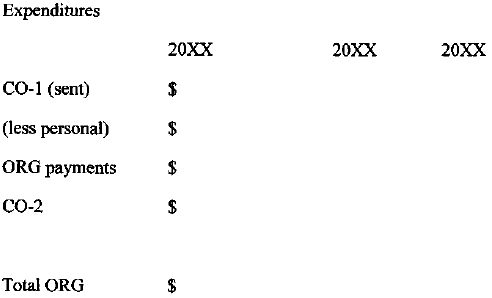
ORG receives CO-1 donations, and money from donation cans in 11 stores around City, State. Founder stated the CO-1 account is shared between himself and ORG.CO-1 statements from 20XX through 20XX report the following revenues, consisting of purported donations and personal income from Founder and his younger brother's business:

CO-11's receipts totaled $* * * and $* * * in 20XX and 20XX, respectively. On July 30, 20XX, Founder stated that these funds were from the festival conducted by Founder's brother. ORG let CO-11 use its pay pal account and the funds were paid back to Founder's brother.
On July 6, 20XX, The Revenue Agent asked ORG if it had located any records that it "tossed out" for the 20XX year and to provide receipts, invoices and similar documentation supporting all organizational expenditures and how they served an exempt purpose for years 20XX & 20XX. On July 30, 20XX Founder stated that he has nothing.
ORG provided names and phone numbers of individuals for the Service to contact as references. ORG provided email correspondence from donees1 for the current year (20XX).
Founder has family in Country and wire transfers (CO-2) the money to family members which is used to purchase bread and distribute to poor children in the streets of Country. On April 30, 20XX, ORG provided pictures of individuals distributing bread to children in Country. The photographs' source was from Founder's relative, RA-1. RA-1 provided the photos in various emails in 20XX & 20XX along with brief statements about the distribution. On July 30, 20XX, Founder stated that the bread distribution and photography is no longer a permitted due to security concerns in Country.
During the form 1023 application process, ORG did not inform the Service that it would be sending money overseas to family members. ORG stated that it would conduct an extensive grant selection process and exercise expenditure responsibility with respect to foreign grants. The Service asked questions with respect to its operations in Country. On August 2, 20XX, the Service asked:
1 a) "Are contributions paid only to organizations exempt under 501(c)(3). If not, please explain the criteria that will be used to maintain expenditure responsibility. How will you ensure that the grants paid will be used for exempt purposes under IRC 501(c)(3)?"
On August 24, 20XX, ORG stated:
Contributions, gifts, and grants are not paid only to organizations exempt under 501(c)(3). Organizations requesting assistance must submit a proposal detailing what items are needed, how the items are to be used, financial information on the organization, and a description of the organizations and its activities. Prior to choosing which organizations will receive assistance the buildings we will meet with the organization leaders [sic]. At this meeting we will request a tour of their facilities and a list of organization leaders, personnel, and volunteers to check against the OFAC list. Our criteria for choosing organizations is demonstration of need through the description and financials submitted in the proposal, best proposed use of the items/funds, and ability to help the most individuals possible.
Each organization will be required to send annual, periodic, and or final distribution reports. The type of report will depend upon the type of distribution (i.e cash or items such as food, clothing, or school supplies). We will also conduct periodical site inspections when deemed necessary by the board. All grantees, be they new or renewal, must go through the same process. This is to ensure preferential treatment is not given to renewal grantees and to ensure all organizations continue to meet our criteria and IRS standards and regulations.
1 b) What Specific practices and safeguards has, or will the organization put in place to ensure that grants to foreign recipients are not diverted for non exempt purposes and overseas activities are in furtherance of its exempt purposes?
i. What kind of due diligence investigation is done in advance of grant making?
ORG response:
Organizations requesting assistance must submit a proposal detailing what items are needed, how the items are to be used, financial information on the organization, and a description of the organizations and its activities.
Prior to choosing which organizations will receive assistance the buildings we will meet with the organization leaders. At this meeting we will request a tour of their facilities and a list of organization leaders, personnel, and volunteers to check against the OFAC list. Our criteria for choosing organizations is demonstration of need through the description and financials submitted in the proposal, best proposed use of the items/funds, and ability to help the most individuals possible.
ii. What provisions are used by grant agreements to ensure grants are used for their intended purpose?
The grant proposal will specify our responsibilities and those of the grantee, obligate the grantee to use the grant funds only for the purposes for which the grant was made, provide periodic written reports concerning the use of the grant funds, require a final written report and an accounting of how grant funds were used, and acknowledge our authority to withhold and/or recover grant funds in case such funds are, or appear to be, misused.
LAW
Section 501(c)(3) of the Internal Revenue Code provides for exemption from taxation for organizations "organized and operated exclusively for religious, charitable, scientific, testing for public safety, literary, or educational purposes, or to foster national or international amateur athletic competition, . . ., or for the prevention of cruelty to children or animals, no part of the net earnings of which inures to the benefit of any private shareholder or individual . . ."
Section 1.501(c)(3)-1(c)(1) of the Income tax regulations states that "An organization will be regarded as 'operated exclusively' for one or more exempt purposes only if it engages primarily in activities which accomplish one or more of such exempt purposes specified in section 501(c)(3). An organization will not be so regarded if more than an insubstantial part of its activities is not in furtherance of an exempt purpose."
Section 1.501(c)(3)-1(c)(2) of the Income tax regulations states that an organization is not operated exclusively for one or more exempt purposes if its net earnings inure in whole or in part to the benefit of private shareholders or individuals. For the definition of the words "private shareholder or individual", see paragraph (c) of § 1.501(a)-1.
Section 1.501(c)-1(d)(1)(ii) of the Income tax regulations states that "An organization is not organized or operated exclusively for one or more of the purposes specified . . . unless it serves a public rather than a private interest. Thus, to meet the requirement of this subdivision, it is necessary for an organization to establish that it is not organized or operated for the benefit of private interests such as designated individuals, the creator or his family, shareholders of the organization, or persons controlled, directly or indirectly, by such private interests."
Section 1.6033-2(i)(2) of the Income tax regulations provides that "Every organization which is exempt from tax, whether or not it is required to file an annual information return shall submit such additional information as may be required by the Internal Revenue Service for the purpose in inquiring into its exempt status and administering the provisions of subchapter F (section 501 and following), chapter 1 of subtitle A of the Code. . . ."
Rev. Rul. 59-95, An organization previously held exempt from Federal income tax was requested to produce a financial statement as of the end of the year and a statement of its operations during such year. However, its records were so incomplete that it was unable to furnish such statements. Section 6033 of the Internal Revenue Code of 1954 provides that every organization, except as provided therein, exempt from taxation under section 501(a) of the Code shall file an annual return, stating specifically the items of gross income, receipts, and disbursements, and shall keep such records, render under oath such statements, make such other returns and comply with such rules and regulations as the Secretary of the Treasury or his delegate may from time to time prescribe. Held, failure or inability to file the required information return or otherwise to comply with the provision of section 6033 of the Code and the regulations which implement it, may result in the termination of the exempt status of an organization previously held exempt, on the grounds that the organization has not established that it is observing the conditions required for the continuation of an exempt status.
Rev. Rul. 56-304, Organizations privately established and funded as charitable foundations which are organized and actively operated to carry on one or more of the purposes specified in section 501(c)(3) of the Internal Revenue Code of 1954, and which otherwise meet the requirements for exemption from Federal income tax are not precluded from making distributions of their funds to individuals, provided such distributions are made on a true charitable basis in furtherance of the purposes for which they are organized. However, organizations of this character which make such distributions should maintain adequate records and case histories to show the name and address of each recipient of aid; the amount distributed to each; the purpose for which the aid was given; the manner in which the recipient was selected and the relationship, if any, between the recipient and (1) members, officers, or trustees of the organization, (2) a grantor or substantial contributor to the organization or a member of the family of either, and (3) a corporation controlled by a grantor or substantial contributor, in order that any or all distributions made to individuals can be substantiated upon request by the Internal Revenue Service.
GOVERNMENT'S POSITION
ORG is not operating exclusively for charitable purposes under 501(c)(3). You do not meet the operational test described in section 1.501(c)(3)-1(c)(1) because you have your assets are not used exclusively for exempt purposes. ORG's CO-1 account, its primary asset, is commingled with Mr. Founder's personal finances. Founder uses the CO-1 account for both personal and organizational matters. In 20XX2 * * *% and in 20XX, * * *% of ORG's CO-1 account revenues were generated by and destined to a different entity owned by Founder's brother. In 20XX and 20XX, * * *% and * * *% of ORG's CO-1 expenditures were Founder's personal. ORG allows its asset to be used by its founder for non exempt personal purposes. Such use constitutes inurement and ORG fails the operational test under Treasury Regulations 1.501(c)(3)-1(c)(1), which states, "an organization will not be so regarded if more than an insubstantial part of its activities is not in furtherance of an exempt purpose."
The Internal Revenue Service asked the Foundation to provide specific information about its actual activities during the years ending December 31, 20XX, 20XX and 20XX. Other than emails and photos of bread distributions, the organization did not show how its expenditures furthered an exempt activity.
The Service asked the organization to provide all books and records of its assets, liabilities, receipts and disbursements. ORG did not provide any receipts, invoices or any other contemporaneous substantiation for its expenditures. ORG "tossed out" its receipts.
ORG failed to disclose its activities during the application process. It did not reveal to the Service that it would be making overseas payments to relatives of its founder, Mr. Founder. ORG stated that it would maintain expenditure responsibility by requiring organizations to submit detailed proposals on how the funds are to be used, financial information on the organization, and a description of the organizations and its activities. ORG stated that it will meet with officers of these potential grantee organizations. The criteria for selecting grant recipients will then be based on need. ORG stated that each recipient organization will be required to send annual, periodic, and final written distribution reports and accounting of how grant funds were used; that it will conduct periodical site inspections when deemed necessary by the board. All grantees, be they new or renewal, must go through the same process.
ORG failed to exercise expenditure responsibility over the funds wired to Country. Instead of providing annual, periodic, or final distribution reports from the grantee organizations to the Service, ORG provided photographs taken by relatives of Founder. Such photographs do not satisfy the expenditure responsibility requirements ORG promised it would exercise, nor do they to prove these wire transfers served a charitable class. ORG does not maintain minutes and has no record of any grant selection process in place (as promised in its application process).
An exempt organization must respond to Internal Revenue Service inquiries to establish that it is entitled to tax exempt status. In this case the taxpayer had failed to establish that it was engaged in exempt activities, that its expenditures were for the purpose of exempt activities, or that its assets did not inure to private shareholders or individuals.
TAXPAYER'S POSITION
The organization has not submitted its position.
CONCLUSION
Exemption under Code section 501(c)(3) for ORG should be revoked effective January 1, 20XX. The organization is required to file Form 1120 for all opened years.
FOOTNOTES
1 To local school for pen pencils notebooks bags, for 1/20XX year & clothing collection drive for 7/20XX
2 Commingling occurred before the application process